

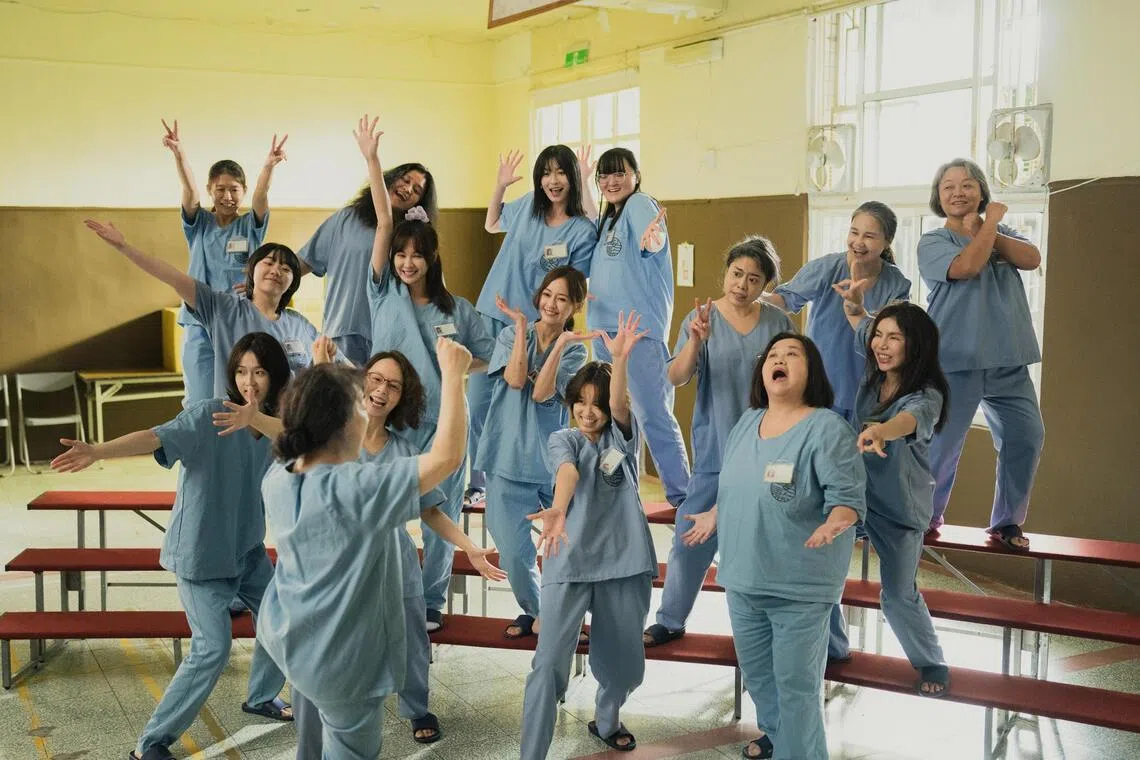
In a remarkable turnaround for Taiwan’s film industry, director Gavin Lin’s Sunshine Women’s Choir has surged to become the sixth biggest domestic film in Taiwanese box office history. Released on December 31, 2025, the women’s prison drama has grossed NT$400 million (approximately US$12.7 million) after just 34 days in theaters, overtaking recent hits like 2021’s Man in Love and 2023’s Marry My Dead Body. This achievement underscores a resurgence in local cinema, driven by strong word-of-mouth promotion and a blend of emotional storytelling with motivational themes.
The Story Behind the Success
Sunshine Women’s Choir follows a group of female inmates who discover hope, redemption, and camaraderie through music and singing in a prison choir. Directed by Gavin Lin, who previously helmed the emotional blockbuster More Than Blue (2019), the film reunites him with star Ivy Chen and screenwriter Hermes Lu.
The cast is led by Chen alongside Taiwan-Japan icon Judy Ongg—marking her first Taiwanese film in 47 years—and supporting actresses like Chung Hsin-ling, Amber An, and May Sun. Produced by Lin’s new company, Star Generation Culture & Entertainment, the movie world-premiered at the 2025 Taipei Golden Horse Film Festival, where it garnered buzz for its heartfelt narrative and female-led ensemble.
The film’s box office journey started modestly, earning NT$10 million (US$316,000) in its first five days, trailing behind Hollywood giants like Avatar: Fire and Ash and Zootopia 2, as well as the local documentary Hero! Hito!.
However, positive audience reactions fueled a dramatic climb: it jumped 118% in its second week to NT$28 million by January 11, hit NT$100 million by January 20, NT$250 million by January 26, and NT$300 million by January 29. By February 2, 2026, it had crossed the NT$400 million threshold, solidifying its place among Taiwan’s all-time top earners.
This success echoes Lin’s track record of creating emotionally resonant films that resonate with local audiences, blending drama with uplifting elements.


Historical Context: Taiwan’s Box Office Titans
Taiwanese cinema has a rich history of box office successes, often reflecting cultural identity, romance, and historical narratives. The industry boomed in the mid-20th century with Taiwanese-language films (estimated 1,000–2,000 produced between 1955 and 1981, though fewer than 200 survive today due to preservation challenges). However, production plummeted in the 1990s—from 81 films in 1990 to just 16 in 1999—amid competition from Hollywood and Hong Kong imports.
The revival began in the late 2000s, with films that captured local nostalgia and youth culture dominating the charts. Here’s a look at the top-grossing Taiwanese films of all time (based on domestic earnings in NT$ million, as of early 2026):
| Rank | Film | Year | Gross (NT$ million) | Genre/Plot Summary |
| 1 | Cape No. 7 | 2008 | 530 | Romantic comedy about a failed musician forming a band in a small southern Taiwanese town to deliver undelivered love letters from the Japanese colonial era. Directed by Wei Te-sheng, it sparked a renaissance in local cinema. |
| 2 | Warriors of the Rainbow: Seediq Bale | 2011 | 472 | Epic historical drama depicting the 1930 Wushe Incident, where indigenous Seediq people rebelled against Japanese colonial rule. Also by Wei Te-sheng, it’s a landmark for portraying Taiwan’s indigenous history. |
| 3 | David Loman | 2013 | 430 | Comedy following a bumbling gangster navigating family and crime in modern Taiwan. A crowd-pleaser blending humor with action. |
| 4 | You Are the Apple of My Eye | 2011 | 425 | Coming-of-age romance based on director Giddens Ko’s semi-autobiographical novel, chronicling high school crushes and youthful mischief in 1990s Taiwan. |
| 5 | Our Times | 2015 | 410 | Nostalgic high school romance about a girl reliving her youth through memories of first love and friendships. Directed by Frankie Chen, it highlighted female perspectives in Taiwanese storytelling. |
| 6 | Sunshine Women’s Choir | 2025 | 400 | Women’s prison drama about inmates finding purpose through choral music (as detailed above). |
These films often draw from Taiwan’s complex history, including Japanese colonialism (1895–1945), the post-World War II Kuomintang era, and modern identity struggles. Earlier milestones include Hou Hsiao-hsien’s A City of Sadness (1989), which addressed the 228 Incident—a pivotal 1947 uprising—and won the Golden Lion at Venice, boosting international recognition.
The New Taiwan Cinema movement of the 1980s–1990s, led by directors like Edward Yang (Yi Yi, 2000) and Tsai Ming-liang (Vive L’Amour, 1994), focused on urban alienation in Taipei, though these were more arthouse than commercial hits.
More recent entries like Kano (2014, NT$330 million), a baseball drama set during Japanese rule, and Marry My Dead Body (2023, NT$364 million), a supernatural comedy about a cop marrying a ghost, show a shift toward genre-blending to appeal to broader audiences.
The Current State of Taiwan’s Film Industry
Taiwan’s film sector is in a phase of recovery and adaptation, buoyed by government support but challenged by global competition and shifting viewing habits. In 2025, the total box office revenue reached approximately NT$8.04 billion (US$250 million), a 29.8% increase from 2024, marking the highest post-pandemic figure. However, this remains 21.1% below 2019 pre-COVID levels. Ticket sales hit 27.41 million, down slightly from 2023’s 29.24 million, reflecting higher prices for premium theaters boosting revenue.
Domestic films hold a modest market share—around 15% on average. In the first half of 2025, 57 local films were released (consistent with 2024), earning NT$241 million (8.21% of the total NT$2.94 billion box office).
No Taiwanese film cracked the top 10 in that period, which was dominated by Hollywood blockbusters and Japanese animations like Demon Slayer: Kimetsu no Yaiba – Infinity Castle (NT$846 million annually). Hits like 96 Minutes (2025, NT$200 million+), an action thriller, and horror films such as Mudborn demonstrate growing diversity in genres, including supernatural and VR-themed stories.
The industry produced 58 domestic films in 2023 (37 features, 1 animation, 20 documentaries), with screens totaling 955 nationwide. Government initiatives via the Taiwan Creative Content Agency (TAICCA) have fostered co-productions (e.g., with Japan and Thailand) and international festivals like TCCF, which saw record attendance in 2025.
Challenges include policy restrictions for mainland China exports, where Taiwanese films face censorship and competition from booming domestic productions. Additionally, 70% of Taiwanese adults watch content on phones, pressuring cinemas to innovate.
Despite these hurdles, successes like Sunshine Women’s Choir signal optimism. The film not only revives interest in motivational dramas but also highlights women’s stories in a male-dominated industry. As Taiwan’s cinema evolves, blending tradition with modern genres, it continues to carve a niche globally—evident in 2025’s Oscar nominee Left-Handed Girl and Golden Horse winners.
In an era of streaming dominance, Sunshine Women’s Choir proves that compelling local narratives can still pack theaters, offering a beacon of hope for Taiwan’s resilient film landscape.
