

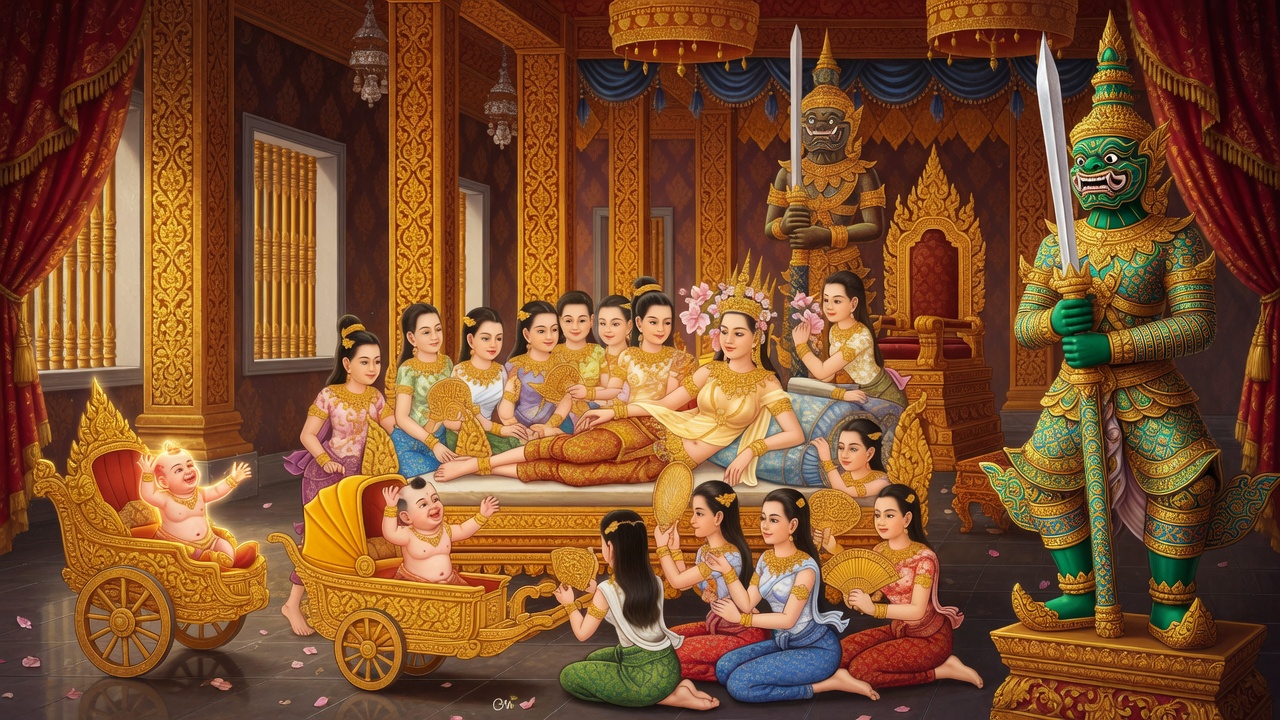
If you think Hansel and Gretel is dark, buckle up, buttercup. Thailand has gifted the world a Southeast Asian epic that’s equal parts family drama, horror flick, and star-crossed romance. Meet Nang Sip Song (The Twelve Sisters), also known as Phra Rot Meri. It’s a story so juicy it makes Game of Thrones look like a Hallmark special.
The Banana Bargain That Backfired
Once upon a time in old Siam, a wealthy merchant and his wife desperately wanted kids. No luck. So the husband does what any rational person would do: he offers 12 bunches of bananas to a magical tree spirit. Lo and behold, the wife gets pregnant… twelve times. All girls.
The merchant’s joy quickly sours as the family fortune evaporates faster than ice cream in Bangkok traffic. Twelve daughters? That’s not a blessing—it’s an expensive grocery bill. In a move that would get him canceled on modern social media, Dad twice abandons the girls in the forest. The youngest cleverly tries leaving a trail the first time, but Dad gets smarter (or meaner) on round two.
Enter the “Nice” Ogress
Fortunately (or not), the starving sisters stumble upon a kind, beautiful woman named Santhumala (or variations like Santa Mala in the retelling). She takes them in, feeds them, and plays the perfect adoptive mom—until a nosy local spills the beans: she’s actually a flesh-eating ogress (yaksha) who plans to fatten them up for dinner.
The sisters bolt, bathe in a river, and catch the eye of a passing king. He marries all twelve on the spot. Polygamy with supermodel sisters? Living the dream.
The Queen’s Revenge: Eyes Wide Shut
Santhumala tracks them down, shape-shifts into an even hotter version of herself, and seduces the king into making her his #1 queen. The jealous sisters aren’t exactly welcoming. So she pulls the classic “I’m dying, honey” routine and claims the only cure is a potion made from the eyes of the twelve sisters.
The lovesick king agrees. Eleven sisters lose both eyes; the youngest keeps one (echoing an earlier act of minor mercy with some fish). Then they’re dumped in a pitch-black cave with orders: no food, no help. Oh, and they’re all pregnant.
Cave Life: The Darkest Potluck
Starvation hits hard. The babies are stillborn or die quickly. In one of the most gruesome family bonding moments in folklore, the sisters chop up the bodies and share the “meat” to survive—except the youngest, who secretly raises her son, Rothasen (or Rothfasen/Phra Rot in various tellings). He grows up sneaking out via a secret passage, winning money at cockfights and games, and feeding the family like a pint-sized hero.
The Hero, the Flying Horse, and the Cannibal Love Triangle
Rothasen becomes a local legend. The king invites him to the palace for games (and probably to show off). Santhumala recognizes the threat, fakes another illness, and sends him on a quest to her old kingdom—where her adopted daughter Meri (or Mary) has instructions: “Eat this guy.”
A wise hermit (rishi) intervenes with a flying horse and swaps the “eat him” note for “marry him.” Meri, who turns out to be beautiful and kind-hearted, is thrilled. They wed, but Rothasen can’t forget his mom and aunts. He gets Meri drunk, steals back the magical eyes (and some ointment), and flies off.
Meri wakes up, goes full giantess in heartbreak, and chases him. He creates magical obstacles—including turning space into an ocean—while promising to return. He does return after slaying Santhumala, restoring the sisters’ eyes and status. But Meri has died of a broken heart.
In true tragic-romance fashion, she vowed to follow him through reincarnations. Rothasen carries her body and joins her in death. Legend says they find each other in every lifetime.
Why This Tale Endures
Beneath the cannibalism and eye-plucking lies a story about family loyalty, karma, redemption, and the pain of impossible love. It’s a Jātaka tale linked to the Buddha’s previous lives, with Rothasen as a bodhisattva figure. Versions pop up across Thailand, Cambodia (as Puthisen Neang KongRei), Laos, and beyond—proof that great storytelling travels farther than a flying horse.
Next time you’re complaining about your in-laws, remember: At least they’re not asking the king to harvest your eyeballs for soup. Thai folklore doesn’t mess around—it delivers the drama with a side of supernatural flair.
Pass the bananas (but maybe skip the tree offering). And if a suspiciously beautiful stranger offers to adopt your kids… run.
