

Those replace the earlier sentence-case lines. Full piece with the corrected heads:
The notebook that kills by handwriting has already survived manga serialization, a landmark anime, Japanese blockbusters, a contested Netflix film, school bans, and a decade of sold-out Asian musicals. What it has not done, until this summer, is face a full English-language staging in a London house built for spectacle. That is the test now running at the Barbican.
Death Note: The Musical opened on July 30 and runs through September 12. It is produced by HoriPro with Trafalgar Theatre Productions, directed by Stephen Whitson, and scored by Frank Wildhorn, with lyrics by Jack Murphy and a book by Ivan Menchell. The London version is not a carbon copy of the 2015 Tokyo original. It arrives with a revised script, new songs, and a British-American creative team assembled to make a Japanese IP readable to an audience that may never have opened Weekly Shōnen Jump.
That is the point. Japanese theater has long imported West End and Broadway titles. Exporting an original musical at this scale, in English, is rarer. HoriPro chairman Yoshitaka Hori has said for years that the trade is unbalanced: Japan pays royalties outbound and rarely collects them inbound. Death Note was designed, from the first New York workshop in 2014, as a correction.
A Notebook Dropped into Weekly Shōnen Jump
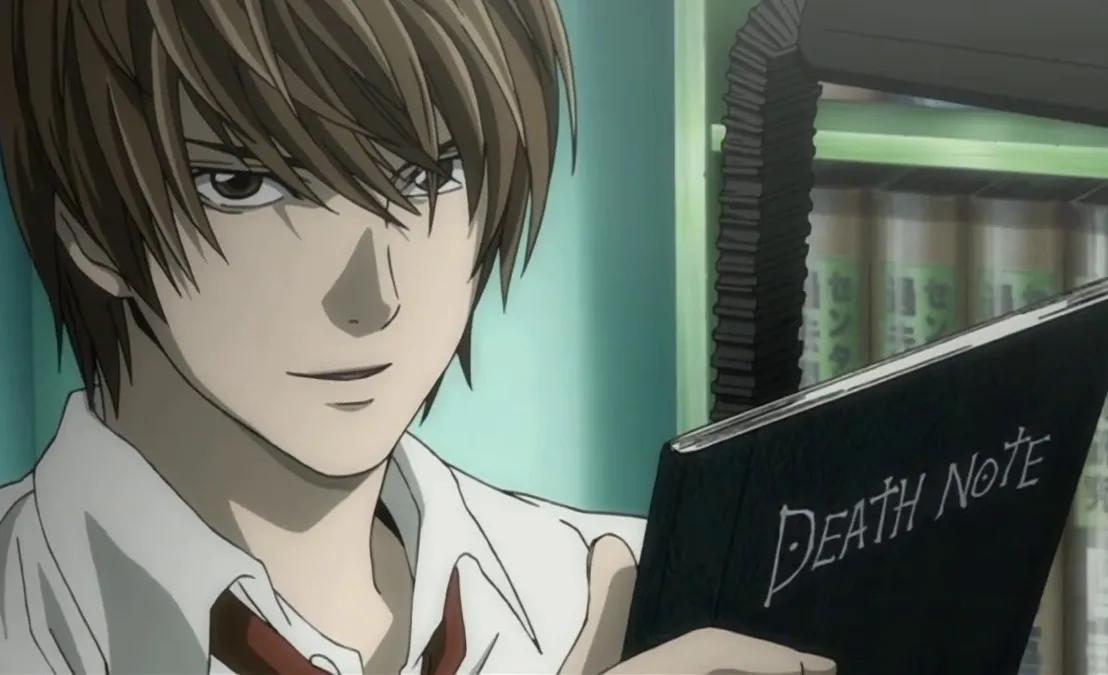
Tsugumi Ohba wrote it. Takeshi Obata drew it. Death Note ran in Shueisha’s Weekly Shōnen Jump from December 2003 to May 2006: 108 chapters, twelve collected volumes. The premise is simple enough to pitch and dense enough to sustain a cult. Light Yagami, a gifted, bored high-school student, finds a notebook dropped by the shinigami Ryuk. Anyone whose name is written in it dies. Light decides the notebook is an instrument of justice. He becomes Kira. The detective known only as L decides Kira is a murderer who must be stopped. What follows is not a superhero story. It is a duel of intellect, pride, and moral language.
Circulation figures have held around 30 million copies worldwide. That is not One Piece territory. It is enough to put a finite, tightly plotted series in the same commercial bracket as Fruits Basket and to keep the books in print two decades later. Viz brought the English edition to North America starting in 2005. The franchise then did what successful Jump titles do: it multiplied.
Madhouse’s 37-episode anime, directed by Tetsurō Araki and aired on Nippon Television from 2006 to 2007, is the version most of the world still means when it says Death Note. Hideki Taniuchi and Yoshihisa Hirano’s score, especially L’s motif, still circulates on short-form video. Cosplay of Light’s college blazer and L’s slouch became a default convention look. The show also traveled as a moral argument. Viewers split, and still split, over whether Light is a utilitarian reformer or a narcissist with a god complex. That argument is the product.


Screens, Box Office, and the Kira Problem
Japan moved first on live action. Shūsuke Kaneko’s two-part 2006 films, with Tatsuya Fujiwara as Light and Kenichi Matsuyama as L, were a commercial event. The second film, Death Note 2: The Last Name, took about ¥5.5 billion in Japan and roughly $54 million worldwide. A 2008 L-centered spin-off followed. In 2016, Death Note: Light Up the New World added another ¥2.3 billion domestically. The films compressed the manga’s long game into star vehicles and still sold tickets because the central image — a name, a page, a death — is cinematic.
Netflix’s 2017 American film, directed by Adam Wingard and relocated to Seattle, did not. It recast Light as Light Turner (Nat Wolff) and L as LaKeith Stanfield, with Willem Dafoe voicing Ryuk. Budget estimates sat around $40 million. Critics and a large part of the existing fandom treated it as a case study in how not to localize a Japanese property: thinner psychology, louder set pieces, a setting that never earned the story’s obsession with systems of justice. Ohba and Obata offered polite comments. The audience score did not. The film remains the franchise’s most visible Western misfire, and a reason later producers have been careful about how much they “Americanize.”
Pop culture impact was not only merchandising. In 2007 and 2008, replica notebooks in Chinese schools, student “enemy lists” in U.S. classrooms, and a Belgian homicide note reading “I am Kira” pulled the title into news copy about copycat behavior. Those episodes did not kill the brand. They confirmed that the idea had left the page and entered the language people use for power, punishment, and fantasy. Later one-shots, including the 2020 story in which a new holder auctions the notebook, treated Kira as history: a mass killer some of the public still wanted to call a god.
How the Musical Was Built
HoriPro approached Wildhorn because the composer already had a Korean and Japanese audience from Jekyll & Hyde and The Count of Monte Cristo. Wildhorn was initially cool to the material. His son, who knew the anime, pushed him. A New York workshop in April 2014 tested the English score with Andy Kelso as Light and Drew Gehling as L before the show was translated for Asia. Jason Howland, who orchestrates the London staging as well, was already in the room.
Tokyo’s Nissay Theatre hosted the premiere from April 6 to 29, 2015, directed by Tamiya Kuriyama. Kenji Urai and Hayato Kakizawa shared Light. Teppei Koike played L. Short Osaka and Nagoya dates followed. The Japanese model is still a limited run: weeks, not months. The show sold out and came back in 2017, 2020, and again in late 2025. That pattern is success in Tokyo. It is not how you mint a global title.
South Korea did that work. A licensed production opened in Seongnam in June 2015 with Hong Kwang-ho as Light and JYJ’s Kim Jun-su as L, then returned in 2017. After OD Company took the rights, the 2022 staging at Chungmu Art Center sold out, extended into the Seoul Arts Center Opera Theater, and returned for an encore at Charlotte Theatre in 2023. It won Best Production (over 400 seats), Best Direction, Best Supporting Actor (Kang Hong-seok as Ryuk), and Best Stage Art at the 7th Korea Musical Awards. Cumulative attendance for the OD era later passed 500,000. The 2025–26 Seoul season at D-Cube Link Art Center ran from mid-October into late May — close to eight months, with a two-week extension. That length is the comparison HoriPro now uses against Japan’s shorter calendars.
Taiwan staged it as well. London first saw the score in concert at the Palladium and the Lyric in 2023, sold out, then waited for a full production. The Barbican run is that production: first fully staged English version, roughly two hours and twenty to thirty minutes with interval, age guidance 12+, tickets from the mid-twenties in pounds. Press night was August 11. Extra performances were added after early dates sold.
The London company is led by Xander Pang as Light and Colin Ryan as L, with Stephanie Zaharis as Misa Amane, Telly Leung as Ryuk, Grace Mouat as Rem, and Paolo Montalban as Soichiro Yagami. Design is by Jon Bausor; choreography by Fabian Aloise; costumes by Sachiko Nakahara. The staging uses a split world: humans below, shinigami on a concrete balcony, Tokyo stacked in projection. Songs circulating ahead of opening included “Where Is the Justice,” “Hurricane,” and “When Love Comes.” The book leans on the first half of the manga and trims the later detective succession. Purists will notice. The West End press mostly did not mind.
The Times, The Stage, WhatsOnStage, The Guardian, and BroadwayWorld came in around four stars: entertaining, propulsive, visually large. Time Out was cooler, three stars, arguing the adaptation should have taken more risks with the source. Audience traffic at the Barbican has included repeat bookers in franchise merch. That mix — critics calling it a night out, fans treating it as pilgrimage — is what a six-week sit-down is supposed to measure.
Why London Is the Real Gamble
Japanese musicals have crossed borders before. They have rarely been asked to hold a major London auditorium on West End terms: English text, local company, reviews that will travel, and a producing partnership that can tour or transfer if the numbers work. HoriPro already has history at the Barbican through Yukio Ninagawa. Returning with an original title, rather than a Shakespeare import, is a different claim.
The commercial logic is straightforward. Manga and anime already did the global marketing. The live-action films proved the story can fill cinemas in Asia and fail when the psychology is sanded down. Korea proved the musical can run for seasons if the staging is aggressive and the casting is star-driven. London asks whether Wildhorn’s power-ballad idiom, which Asia already accepted, can sit next to contemporary West End expectations without looking dated — and whether a Japanese producer can collect the kind of long-tail licensing British and American offices take for granted.
The show is not a referendum on whether Death Note still matters. The 30 million copies, the anime that still converts teenagers, the Kira debates that never closed, already answered that. It is a referendum on form. A story about a boy who thinks he can rewrite the moral order of the world is now being used to test whether Japanese theater can rewrite its own place in the market. The Barbican run ends September 12. What happens after that will tell producers more than another Tokyo revival ever could.
