

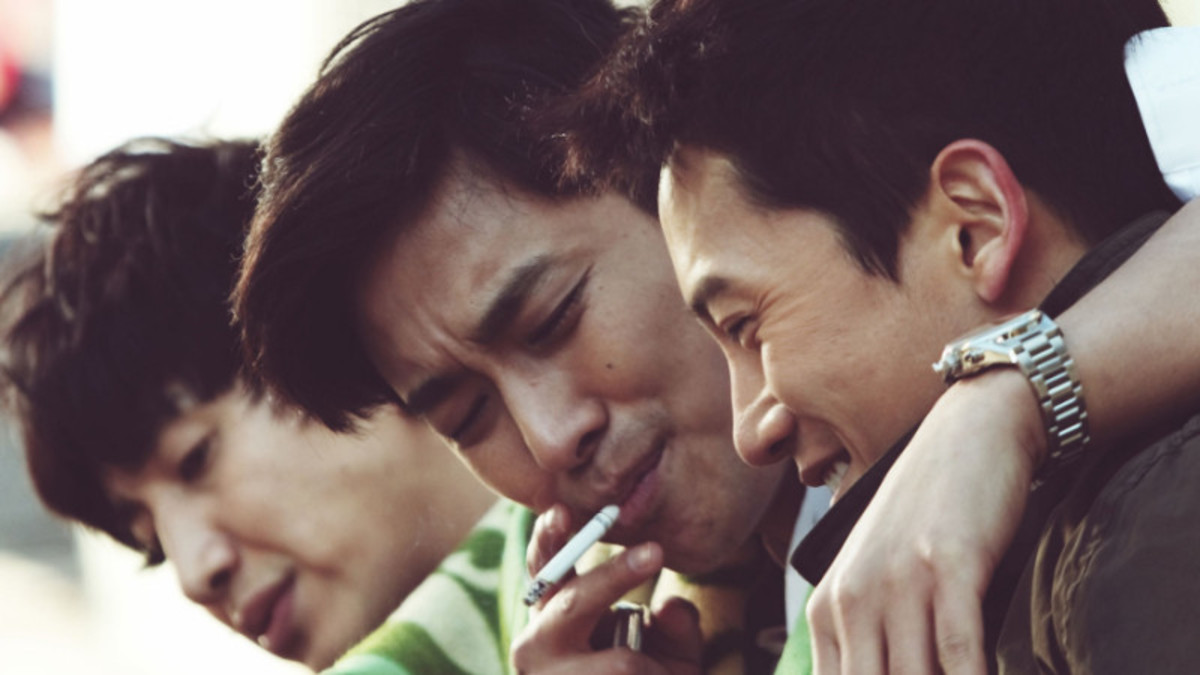
When you watch a film built around friendship, what you’re really searching for is authenticity. You want to see, hear, and feel that connection between people who share no bloodline yet hold each other with a kind of unspoken devotion. You look for that familiar, steady affection between people who don’t technically need one another yet continue to choose one another. You look for those moments when a person reveals their truest self because they’re in the presence of someone who never demands performance. And you look for the way shared history can keep people bound together when they’re forced into unfamiliar, painful territory.
That connection is difficult to fake. It’s the exact reason so many friendship-themed films fall apart despite having compelling stories and sharp dialogue. If the audience can’t feel the chemistry between the actors, the entire structure collapses.
Good Friends (also known as Confession) doesn’t collapse. It holds.
Synopsis
Hyun-tae, Inchul, and Min-soo have been inseparable since grade school. Growing up almost as extensions of one another, they became absorbed into each other’s families. Their bond, however, begins to fracture when one friend’s attempt to help another leads to the accidental death of a family member. What follows is a maze of guilt, fear, and new alliances—because for the first time, they must lie to one another.
Connection and Disconnection
Friendships are stitched together through shared memories, secrets, and embarrassments, but it’s the singular life-altering moments that truly seal them. For these three, that moment arrives early and violently—what began as a mischievous getaway ends in a brush with tragedy. It was a test of their loyalty and their individual moral limits. They survived it, but the impact lingered in ways they never fully acknowledged. Bruises don’t disappear just because no one talks about them; they simply wait for someone to reopen them.
That event gave their friendship a shape that looked perfect from afar. The problem is that none of them were perfect individually.
Hyun-tae has a warm home life with his wife and daughter, but carries a cold, unresolved distance from his parents—so much so that Inchul is the one who keeps up contact with them. Inchul, the outwardly confident one with the expensive apartment, can barely afford the life he presents. He floats through a relationship that borders on exploitation, revealing a man far more fragile than he’d ever admit. Min-soo, quiet and passive, works every odd job he can find and clings to his friends as the only family he has left.
They understand each other’s flaws without ever naming them. They give one another the dignity of pretense: pride protected, needs quietly filled. Inchul claims he’s tired of looking after Min-soo, yet he continues to do it—because for all the financial chaos he hides, Min-soo offers him something he can’t manufacture: a place where he is needed. Meanwhile, Hyun-tae provides support but with boundaries, always keeping a slight physical and emotional distance even as he remains the moral anchor of the group.
That distance is visible everywhere. While the other two drift through their own instability, Hyun-tae marries, becomes a father, and lives what appears to be a steady life. Yet in group scenes, he sits just a bit apart—an arm’s length away, sometimes across from them, the physical blocking subtly mirroring the internal space he maintains.
They Are Not Who You Think They Are
Their dynamic carries an unspoken sublayer: they are with each other because they want to be, yes, but also because they fulfill needs none of them can admit aloud.
Hyun-tae seems steady but is quietly harboring the coldest detachment of all—his refusal to face his parents reveals a deeper emotional danger. Inchul appears successful but crumbles without the affirmation Min-soo provides. Min-soo appears dependent yet is, in many ways, the emotional center that keeps the group functional.
The irony is that everyone believes someone else in the trio has it together.
Direction and Cinematography
The film’s visual language reinforces this emotional layering. Director Lee Do-yoon leans heavily into darkness—scenes with all three characters are often dim, with only partial lighting on their faces or hands. The world brightens noticeably only when the trio is not together, a visual cue that their unity carries shadows.
As the plot thickens, the darkness deepens. By the latter half, the scenes are so murky you almost have to adjust your posture to follow the actors’ expressions. It’s deliberate—a physical reminder that the friendship is sinking under the weight of secrets, guilt, and inevitability.
Ending
Ji Sung, Ju Ji-hoon, and Lee Kwang-soo deliver performances that feel lived-in rather than performed. Their chemistry is precise in the small details: the way one looks away when the others talk, the casual dismissal of an annoying habit, the instinctive lean of a shoulder. Those subtleties are what make their bond believable.
As the story moves toward its conclusion, there’s a clear point where the narrative can no longer reverse course. By then, the question isn’t whether the friendship can be saved—it’s how each man will meet his fate. The ending is consistent with the character work established from the beginning. It doesn’t necessarily shock, but it stays honest.
Good Friends / Confession offers a sharp, emotionally layered look at a familiar premise: a bond fractured by a good intention that spirals out of control. Its strength lies not in novelty but in execution—how it understands male friendship, how it exposes the fragility beneath loyalty, and how it captures the quiet grief of realizing that the people who once felt like your entire world can become strangers across a single decision.
