

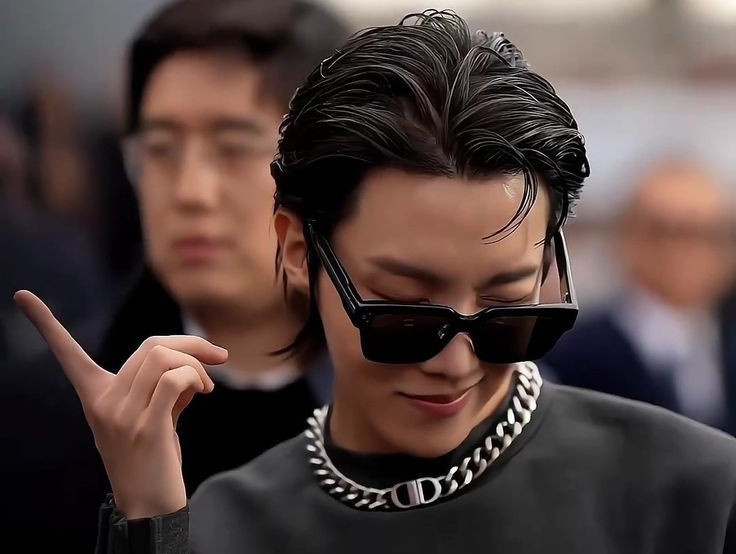
By the end of 2025, it became clear that J-Hope was no longer operating inside familiar territory—not musically, not structurally, and not professionally. This was the year he pushed past the comfort of mastery and into deliberate exposure: new collaborators, new markets, new performance demands, and a touring scale that few Asian soloists have ever attempted, let alone completed successfully.
What followed was not a cautious expansion, but a decisive one. J-Hope stress-tested his creativity and influence—on the road, on charts, and in rooms where solo artists are rarely given margin for error. The result was a year that carved his name into industry record books in ways that now function as reference points rather than milestones.
Concerts & Live Performance: Turning Risk Into Infrastructure
If 2025 proved anything, it’s that J-Hope’s reputation as one of K-pop’s strongest performers was never confined to group context. His first world tour, HOPE ON THE STAGE, closed with $79.9 million in gross revenue, making it the highest-grossing tour by a solo Asian native act in history.
He became:
- The first Asian native soloist to sell out a stadium in the U.S.
- The first to sell out stadiums across two continents—Japan and North America
- The highest-grossing Korean soloist in North America, with $35 million from the region alone
- On Billboard’s 2025 Year-End Top Tours Chart, j-hope ranked #32, officially becoming:
- The highest-ranking K-pop soloist in chart history
- The only Asian soloist on the list
- The third-highest Asian act overall, surpassing long-standing touring benchmarks
Pollstar’s Mid-Year Top 100 Tours (2025) placed HOPE ON THE STAGE at #9, marking j-hope as the highest-ranking Asian soloist ever recorded on the list and the #2 biggest K-pop tour of the year at mid-cycle.
Critically, it was a triumph. Established outlets consistently emphasized endurance, precision, and cohesion. Reviews described the show as relentless but controlled—a full-body performance that balanced athleticism with musical clarity. Multiple publications highlighted his stamina across extended runtimes, his command of pacing, and the way live arrangements preserved intensity without overwhelming vocal delivery. Rather than leaning on scale to mask gaps, the production amplified his strengths: movement discipline, crowd calibration, and emotional timing.
That reputation carried into festival stages as well.
In 2025, BTS’s J-Hope headlined Lollapalooza Berlin, delivering a 90-minute set that seamlessly blended solo material with reworked BTS tracks including “MIC Drop,” “Dynamite,” and “Butter.” The performance followed his 2022 Chicago debut, where he became the first South Korean act to headline Lollapalooza—a trajectory that now reads less like novelty and more like structural validation.
Even the tour’s cinematic extension performed as an event.
HOPE ON THE STAGE: LIVE VIEWING debuted in the Top 10 of the U.S. domestic box office, opening with $939,000 and ultimately grossing $4.1 million worldwide—a rare crossover success for a concert film tied to a solo Asian artist.
Forbes Korea summarized the arc succinctly, calling the tour a “180-minute sprint” and noting that its success signaled J-Hope had reached “the pinnacle of stardom by K-pop standards.” More telling was the reasoning: not hype, but structure—production coherence, audience communication, and live execution that exceeded existing genre expectations.
Charts & Consumption: Consistency Over Novelty
On the charts, J-hope’s year wasn’t built on a single breakout moment but on accumulation.
He now holds the most Billboard Hot 100 entries by a Korean soloist, with eight total entries, and made history in 2025 as the first Asian rapper and K-pop soloist to chart five solo tracks in a single year.
Every single released after his military discharge entered the Hot 100:
- “LV Bag” (with Pharrell Williams & Don Toliver) — #83
- “Mona Lisa” — #65
- “Sweet Dreams” — #66
- “Killin’ At Girl” — #40
- “Spaghetti” (with LE SSERAFIM) — #50
On streaming platforms, longevity matched momentum.
Jack In The Box (HOPE Edition) surpassed 1.022 billion streams on Spotify, confirming sustained engagement rather than front-loaded spikes.
On YouTube, “Mona Lisa” became the most-watched MV by a Korean male soloist in 2025, surpassing G-Dragon’s “Too Bad”—a notable shift given the platform’s historical bias toward legacy acts.
In physical formats, j-hope quietly rewrote another record:
He is the first and only Korean soloist to hold the most Top 10 entries in Billboard Vinyl Albums Chart history, with:
- #4 — Jack In The Box
- #6 — Hope On The Street, Vol. 1
This wasn’t nostalgia marketing. It reflected trust—listeners willing to commit beyond playlists.
Awards & Industry Recognition: Credibility Across Markets
By year’s end, J-Hope’s recognition spanned regions and criteria.
- Best Singer, 52nd Korea Broadcasting Awards — the first soloist to win since 2016
- Ranked #6 Top Male Korean Idol of 2025 by Forbes Korea
- Ranked #16 on Forbes Korea’s “Top 30 Korean Idols of 2025”
- The only Korean soloist listed in Bloomberg’s Pop Star Power Ranking
- Internationally, he claimed three major Brazilian awards:
- Asian Artist of the Year — Sec Awards
- International Feature of the Year — Sec Awards
- Asian Artist — BreakTudo Awards
The geographic spread matters. These weren’t concentrated fandom-driven honors; they reflected visibility across broadcast, finance-adjacent media, and emerging global music markets.
Brand Partnerships: Alignment Over Saturation
J-Hope’s most visible partnership of the year—Human Made—continued his preference for selective alignment rather than volume endorsements. His collaboration with Pharrell Williams and Don Toliver on “LV Bag” functioned simultaneously as music, campaign anchor, and brand signal for Louis Vuitton.
Rather than positioning him as a static ambassador, the campaign leaned into creative parity. j-hope wasn’t modeling culture; he was participating in it.
Creative Growth: Learning in Public
What ultimately defines j-hope’s 2025 isn’t output—it’s methodology.
Historically, he’s been an artist who controls his work end-to-end. This year marked a conscious departure. For the first time, he actively chose to work with external producers, not for efficiency, but for expansion—learning beyond his long-standing cultural influences and internal instincts.
His run of English-language singles wasn’t a pivot; it was a test. Going fully pop placed him in unfamiliar terrain, forcing adaptation in phrasing, vocal delivery, and narrative restraint. Touring amplified that risk. Live repetition exposes weaknesses quickly. Instead of retreating, he refined.
This aligns with what he articulated to ELLE Korea when reflecting on his trajectory from Hope World to SPAGHETTI:
“I think I’m the type who only truly understands by experiencing things myself. I write songs, perform them, feel the reactions, and through that, I continue to search for what suits me and what feels natural… Going through various genres and performances, I feel like I’m growing in my own way. At the same time, I feel my colour is becoming more solid and refined.”
Growth didn’t dilute his identity—it sharpened it.
Getting To Know J-Hope
I don’t think a lot of people fully grasp how made J-Hope is as an artist. What he managed to do is rare. Even artists backed by major labels, artists who’ve been Billboard Hot 100 mainstays for years, often struggle the moment you put them in a theater and ask them to fill seats.
J-Hope didn’t just fill them—he sold out his entire tour, oversold multiple venues, and accumulated a billion streams on an album organically. That level of conversion—from listener to ticket buyer—is elite. There are very few artists operating at that tier. He’s probably in the top five percent, realistically.
A lot of artists we assume are “big” are mostly smoke and mirrors. They chart, they trend, but they can’t move rooms. J-Hope can and did. Like every member of BTS, his priority right now is the group comeback, and that makes complete sense. That reunion alone will push him into another phase of growth—reintegrating with the group after everything he’s experienced on his own. He’s going to bring something new back with him.
And when that chapter is written—after the commitments are fulfilled and the history they’re about to make is firmly on the record—I have no doubt he’ll step out again on his own. Watching how he continues to grow from there is going to be genuinely exciting.
