

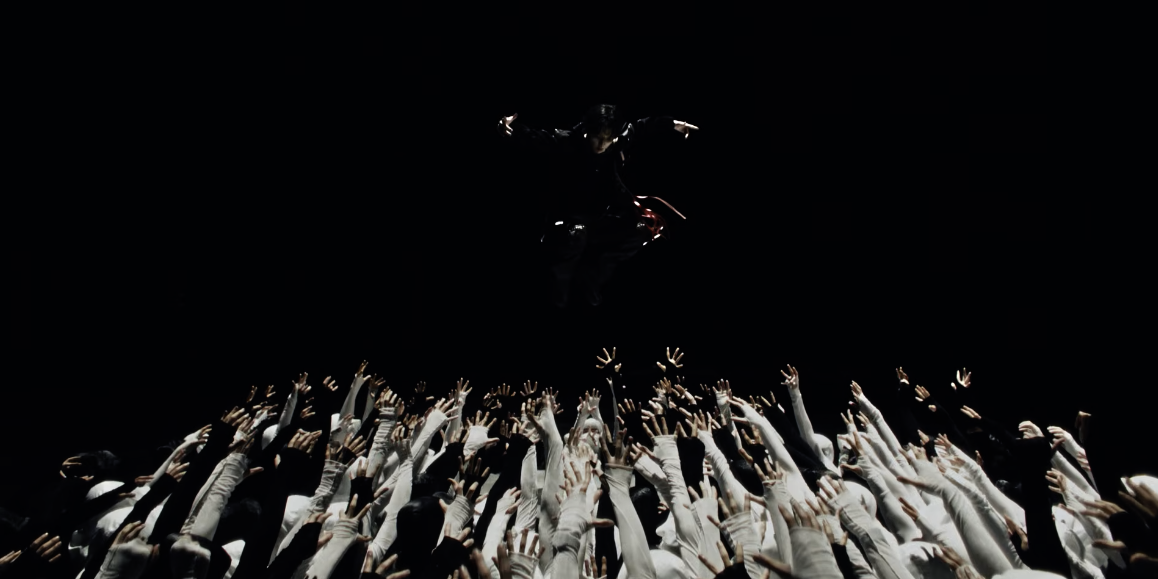
At first glance, the video appears to be a showcase of Korean cultural imagery. Tigers. Ancient Hangul. Silla-era artifacts. Eclipse symbolism. Black-and-white duality. Shamanic movements. The visual language is unmistakably Korean.
But the deeper I went, the more I started noticing that these references weren’t simply scattered throughout the video. They seemed to converge toward a particular moment in history.
A moment that helped shape the Korean peninsula.
Specifically, the story of Gwanchang, the young Hwarang warrior whose death during the Battle of Hwangsanbeol became one of the defining legends of the Silla Kingdom.
Let’s start with the symbol that appears almost immediately: the tiger, or in native Korean, the Beom.
BEOM


From the get-go we see the fingers of the members depicting that of a tiger and obviously their referencing the BEOM.
The national animal of South Korea (Republic of Korea) is the Siberian tiger (also called the Korean tiger or horangi in Korean). “Beom” (범) is the pure/native Korean word for “tiger” (the more common/modern word is horangi 호랑이).
It symbolizes strength, courage, and protection in Korean culture for centuries.
Tigers appear heavily in Korean folklore, myths (like the Dangun legend), art, and even as mascots (e.g., Hodori for the 1988 Seoul Olympics).
Korea was historically known as the “Land of Tigers” because the peninsula’s mountainous terrain was once home to many of them.
Sadly, wild tigers are now extinct in South Korea, but the animal remains a powerful cultural icon.
The Taegeuk / Yin-Yang


Stray Kids was always Heavy in yin-yang symbolism. Official pop-up store MD included Yin-Yang bracelets and SKZOO keyrings. Fans and analysts noted mirrors, racing motifs, and explicit balance/opposites themes in the visuals and lore.
However, the red and blue circle in the Korean flag is called the Taegeuk (태극), which literally means “Supreme Ultimate.”
Given the heavy references to Korean culture, the symbol could be referencing the Taegeuk more for this MV.
Hunminjeongeum
If you look closely at the surface of the dark stone spiral, there are faint inscriptions of archaic Korean characters. This references the Hunminjeongeum, the original 15th-century manuscript that introduced Hangul (the Korean alphabet).
Stamping this script onto the foundational stone literally grounds the choreography in the birth of Korean literacy and cultural identity, framing the performance as an extension of Korean history.
Silla Gold Crowns (Geumgwan)


The branch-like, antler-shaped structures radiating outward from the perimeter are a direct visual match for the stylized motifs found on 5th-6th century crowns from the Silla Kingdom.
These symbolized a bridge between heaven and earth, representing the king’s dual role as a political ruler and a high shaman.
Felix Battle With Himself
Felix looked like he was doing Tae Kwon Do. However, there is another ancient martial art with fluid, rhythmic folk game/martial art characterized by graceful, dance-like footwork and sweeping kicks, Taekkyeon.
Modern Taekwondo was actually developed in the 1940s and 50s following the Japanese occupation of Korea. Its physical foundation is heavily based on Shotokan Karate, mixed with Chinese martial arts.
When the creators of Taekwondo were establishing a unified national martial art in the 1950s, they deliberately integrated Taekkyeon’s signature high, fast, and spinning kicks to give Taekwondo a distinctly Korean identity, separating it from Karate.
The name “Taekwondo” was chosen specifically because it sounded phonetically similar to Taekkyeon, anchoring the new art to Korea’s ancient heritage.
Felix battling himself represents the literal synthesis of Taekwondo’s history. It is a visual representation of the art’s dual nature: the fierce, rigid, combat-ready military discipline of the ancient Hwarang/Karate roots fighting against the fluid, expressive, rhythmic grace of Taekkyeon.
Painting On The Floor With Their Hands


Painting the floor with their hands heavily mimics traditional Korean shamanic cleansing gestures and specialized regional folk dance aesthetics.
1. Shamanic Cleansing / Exorcism (Gut & Salpuri)
In traditional Korean shamanism (Gut) and the celebrated folk dance Salpuri (literally meaning “to wash away evil spirits or sorrow”), performers use sweeping physical gestures directed toward the ground.
Rather than dancing strictly upright, performers drop their center of gravity close to the earth and use flat palms or white silk scarves to figuratively “sweep” away bad luck, accumulated negative energy, or generational trauma (Han) from the floor.
By incorporating this ground-sweeping gesture, the choreography acts as a stylized ritual to clear the space or canvas for a new era.
2. Traditional Calligraphy Brushstrokes (Seoye)
The fluid, heavy dragging of hands across the floor mirrors the physical discipline of Korean calligraphy (Seoye).
In historical Korean art, writing characters on a flat surface was considered a martial and spiritual practice that engaged the entire body, not just the wrist.
Dragging the hands along the floor visually mimics an ink brush saturated with black ink carving out the very historic Hangul characters seen etched into the stage floor beneath them.
Seokguram Grotto Reference
The circular arrangement of stone-carved Buddha figures strongly evokes the architectural layout of Seokguram Grotto, a 18th-century UNESCO World Heritage site in Gyeongju, South Korea.
Seokguram features a massive central stone Buddha surrounded by a circular chamber of relief carvings and smaller deities on the walls.
Goguryeo Tomb Murals


The Central Emblem: Hyeonmu (The Black Tortoise): The creature at the exact center—a tortoise intertwined with a serpent—is Hyeonmu, one of the Four Guardian Deities (Sasin) in ancient Korean mythology.
Hyeonmu explicitly represents the North, the season of winter, and the color black.
The Band. The outer band features dynamic carvings of mounted archers chasing tigers (beom) and deer. This is a direct replica of the famous Hunting Scene (Suryeopdo) from the 5th-century Muyongchong (Tomb of the Dancers).
Hwarang
The Stray Kids members could be playing the Hwarang.
The literal translation of Hwarang (화랑) is “Flower Knights” or “Flower Boys.”
They were aristocratic youths renowned for their physical beauty, fine clothing, and cosmetics. They utilized this soft aesthetic to project status and spiritual purity, which contrasted sharply with their legendary, brutal martial prowess.
They were elite, highly trained military combatants who fought and died on actual blood-soaked battlefields.
The Hwarang practiced Hwarang-do, a martial art heavily anchored in mountain shamanism. In ancient Korean lore, the mountain god’s messenger is the Siberian tiger (beom). Hwarang warriors routinely trained in the wilderness to internalize the tiger’s raw, ferocious hunting instincts, blending spiritual purity (white) with predatory violence (the tiger).
The Hwarang lived by five strict secular commandments. Two of these core rules were “Fight with courage” and “Never retreat in battle.”
The Unification of the Three Kingdoms and Martyrdom of Gwanchang
The intersection of Silla, the Hwarang (and their connection to tigers/beom), the contrast of black and white, and the concept of the White-Clad People (Baekui Minjok) played a definitive role in Korea’s most foundational military era: The Unification Wars of the Three Kingdoms (7th Century CE), culminating in the legendary Battle of Hwangsanbeol (660 CE).
Silla fought its rival kingdom, Baekje, for total control of the Korean peninsula.
- The Crisis: Silla’s massive army of 50,000 was repeatedly repelled and demoralized by a desperate “death band” of 5,000 elite Baekje soldiers led by General Gyebaek.
- The Martyrdom of the White-Clad Knights: To break the stalemate, a young Silla Hwarang named Gwanchang charged the enemy line entirely alone. He was captured, spared for his bravery due to his youth, and sent back. He immediately charged again, wearing his pristine warrior garments. This time, he was executed, and his body was returned tied to his horse.
- The Shift: Seeing the pure white garments of their young noble knight stained in blood ignited a furious, tiger-like ferocity in the Silla army. They launched a brutal counter-offensive, annihilated the Baekje forces, and unified the Korean peninsula for the very first time in history.
The Omen of the Fall of Baekje (660 CE)
According to the Samguk Sagi (The History of the Three Kingdoms), the years leading up to the final clash of 660 CE were plagued by a series of bizarre, terrifying omens in the rival kingdom of Baekje.
The royal court recorded eclipses, red moons, and ghost sightings. Most famously, a subterranean omen was discovered where an inscription read: “Baekje is like a full moon, and Silla is like a new moon.”The Interpretation: A court shaman interpreted the eclipse and moon signs to mean that the “full moon” of Baekje had reached its peak and was destined to be swallowed by darkness (an eclipse), while Silla’s “new moon” was just beginning to grow. This destroyed Baekje’s morale right before Silla and Tang China launched their joint invasion.
By using an eclipse alongside Silla artifacts and Hyeonmu (The Black Tortoise), Stray Kids leans into this exact 660 CE cosmology. The eclipse represents the ultimate transition of power—the moment darkness swallows the old world so a completely new empire (or musical dimension) can emerge from the shadows.
